The Window Seat Before It Became a Nook
Explore how the window seat moved from architectural recess to everyday perch, and learn how to read its changing role in a room today.
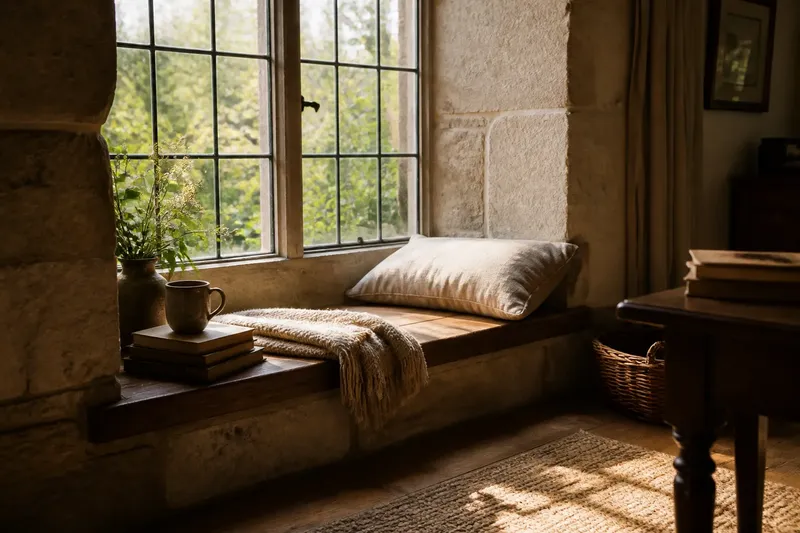
A broad stone ledge sits beneath a deep window opening; a timber board runs across a projecting bay. Both can be called window seats, though neither needs a cushion to serve its original purpose. The history of the window seat begins with these architectural forms, not with the soft, private nook many people picture today.
Window seats began as part of the window opening
In older buildings with deep masonry walls, a window could leave a recess wide enough for a person to sit. A stone or timber ledge used that depth without placing a chair in the middle of the room. In a projecting bay, a fitted bench could follow the line of the windows and make use of the floor area gathered around them.
These forms are easier to describe than to assign to one origin or date. The seat’s shape depended on the building: the depth of its walls, the height of the opening and the way the window was made. A ledge formed by the structure differs from a bench fitted by a carpenter, but both connect a place to sit directly to a window.
Building form shaped the seat’s purpose
A deep recess offered a sheltered place by the glass; a bay made room for a longer bench. The window brought daylight and a view close to the sitter, while the seat occupied space that might otherwise have been difficult to use. These practical qualities explain the feature without assuming that every early seat was designed as a cosy retreat.
Materials and construction varied with the room. A masonry opening might have a hard ledge, while a timber-framed wall could accommodate a separate fitted board or bench. Shutters, window height and the room’s layout all affected how the space could be used. There was no single standard form called a window seat.
Soft furnishings changed how people used the seat
A cushion could make a hard surface more comfortable, and a curtain could frame the view. Once someone put a book, sewing basket or folded cloth nearby, the ledge or bench could become a regular place to pause. These ordinary additions help explain how an architectural feature can acquire the character of a nook without changing its basic construction.
The change is best understood as a shift in use, not a single historical turning point. A built-in seat remains fixed to its opening, but its occupant can use it for a task, a view or a short rest. The word “nook” describes the feeling and habits associated with the place more than a particular building method.
What distinguishes a window seat from a window nook?
Is a window seat always built in?
No. The term can describe a ledge or fitted bench formed as part of the architecture, as well as a separate bench placed beside a window. The distinction is useful when describing how the seat was made, but both arrangements can offer a place to sit near the light.
Does a window seat need a deep recess?
No. A deep opening can provide a natural ledge, but a shallow wall may take a freestanding bench instead. The result will look like furniture rather than a seat formed by the building.
Does a cushion turn a seat into a nook?
A cushion can make a seat more comfortable, but it does not define a nook on its own. The sense of a nook comes from how the place is framed and used, whether by a view, a nearby lamp or an everyday habit.
Why does a window seat feel different from a chair?
Its position directs attention towards the window and makes the seat feel connected to the room’s structure. A chair can move, while a built-in seat follows the opening; a freestanding bench borrows some of that feeling by being placed in the same spot.
Read the building before describing its window seat
Look at the opening, the wall and the seat together. A ledge within a deep reveal suggests that the wall’s construction made sitting possible; a bench fitted across a bay shows how carpentry used the window’s shape. Cushions and nearby objects tell a different part of the story: how an occupant made the place comfortable and personal.
- Observation: The seat is a stone or timber ledge within a deep opening. If it follows the recess, describe it as an architectural ledge; then distinguish that form from a later cushion or other furnishing. Alternatively, if it is a separate board, describe it as a fitted bench.
- Observation: A bench follows several panes in a projecting bay. If it is fixed across the bay, identify it as a fitted seat shaped around the window; then note that the bay provides the setting. Alternatively, if the bench can move, describe it as separate furniture.
- Observation: Cushions rest on a hard ledge. If they can be removed without changing the seat, describe them as later comfort additions; then keep the building form separate from its decoration. Alternatively, if there are no cushions, describe the surface as a plain ledge or bench.
- Observation: A curtain or blind frames the opening. If it creates a sense of enclosure, describe how it shapes the nook; then avoid claiming it formed part of the original seat. Alternatively, if there is no such dressing, focus on the opening and the seat itself.
- Observation: A book, basket or folded cloth is kept nearby. If it suggests a regular activity, describe the seat’s everyday use; then treat that use as the occupant’s choice. Alternatively, if the surface is bare, describe its potential without assigning it a routine.
- Observation: The seat sits beneath a shallow window and is not attached to the wall. If it can be repositioned, call it a freestanding bench by the window; then distinguish it from a built-in recess seat. Alternatively, if it is fixed in place, describe the joinery and its relationship to the opening.
How can you tell what kind of seat a room has?
Say you are describing a room with a deep stone reveal, a timber board fitted across it and a loose cushion on top. First, identify the stone recess as part of the wall and the board as the sitting surface. Next, treat the cushion as a removable comfort layer. The resulting description is precise: a fitted seat uses the depth of the opening, while the cushion gives it a more inviting, nook-like role. If the board instead lifts away as a separate bench, the better description is furniture placed within the recess.
This distinction is useful when looking at an old house, choosing words for a room or considering a contemporary design. A bench beneath a shallow window may borrow the atmosphere of a traditional window seat, but it does not share the same construction. The window seat remains recognisable because it brings a place to sit into close relation with an opening; the nook is the character that use and arrangement can give it.
When searching for the history of the window seat, keep the physical feature separate from the habits gathered around it. The wall and opening explain how a seat could be made; cushions, objects and repeated use explain why it might feel like a place to linger. That distinction leaves room for both a plain stone ledge and a comfortable modern perch without pretending they tell the same story.