A Small Entry Table, Set for the First Look Home
Small entry table arrangement can give keys a reliable home, keep the doorway clear and make a compact entrance feel welcoming without adding clutter.
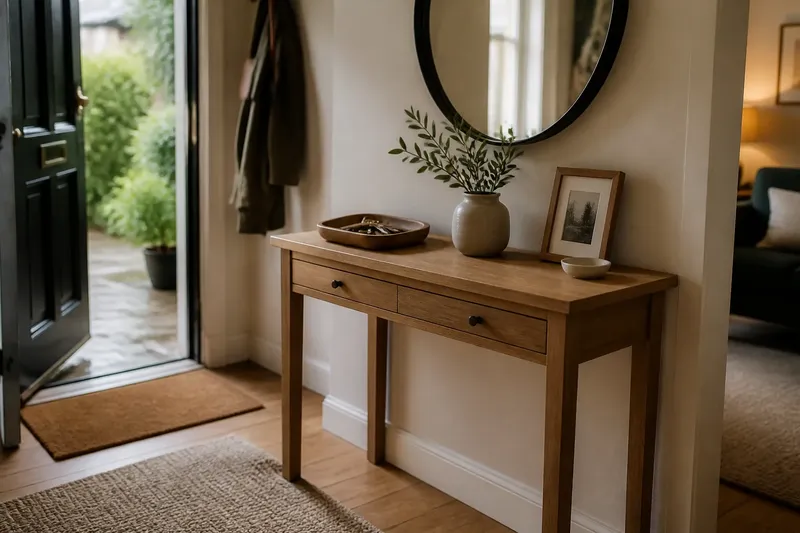
You come through the door with a damp umbrella and keys in your hand. A small entry table arrangement needs to handle those everyday arrivals without turning the entrance into a storage corner. Start with the route people use, then decide what the surface must hold.
Set the table around the way people pass
Before placing anything, walk through the entrance with the table in position. Notice where coats swing, where a bag brushes the wall and which side you naturally approach. Keep the top and the space beneath it clear of anything that catches clothing or narrows the path.
Check the arrangement from the doorway and from the direction you walk in. A lamp base, vase or basket may seem unobtrusive from one angle but project into the route from another. If an item is easy to bump, move it back or choose a smaller piece.
Choose a landing place for everyday carry
Decide which items genuinely need to be set down at the entrance. Keys might belong here, while post may be better taken straight to a desk. Use one shallow tray for small items that travel together; choose a bowl if you mainly need to catch loose keys. Put it within easy reach, without giving it so much space that it becomes a general dumping ground.
Give the tray or bowl a clear purpose. If receipts and coins keep collecting there, empty it as part of putting your keys away. A small drawer can hold spare batteries or a torch if you use them near the door; do not fill it with objects that already have a better home.
Use light for a welcoming, useful entrance
A table lamp can soften the room in the evening and help you see what you are picking up. Place it where the cable can reach a socket without crossing the walking route, and leave room to operate the switch. If a lamp would crowd the usable surface, a wall light or ceiling fitting may suit the entrance better.
Check how the light falls on the table and nearby wall. A shade that directs light into someone’s eyes can be uncomfortable from the doorway; adjust its position or choose a different source. Keep the lamp’s scale and outline in proportion to the table so it does not dominate the entrance.
Give the surface character with materials
Let the table’s finish guide the other materials. A woven tray can soften a smooth painted top, while a plain ceramic bowl can sit comfortably on visible wood grain. One or two contrasting textures are usually easier to live with than a collection chosen only to fill empty space.
Think of the surface like a bedside shelf: it works best when its contents suit the small daily task, rather than trying to hold every attractive object in the room. A framed photograph, a vase or a small dish can add character, but keep anything fragile away from the spot where bags and keys land.
What works on a small entry table?
Can a small entry table hold mail?
It can, if you make room for one clearly defined post tray and sort its contents regularly. If letters begin to spill onto the walking surface, move them to a desk or another place where you deal with paperwork.
Should a mirror hang above an entry table?
A mirror can be useful for a last look before leaving, provided its position suits the wall and the people using it. Keep the tabletop simple enough that the mirror does not make a crowded arrangement feel busier.
What can I put under an entry table?
A basket can hold reusable bags or other items you reach for near the door. If it makes the route awkward or is difficult to pull out, leave the floor beneath the table open.
Use these checks to settle the arrangement
- Check whether the walking route is clear; if a bag or coat catches on the table, move the item causing it or leave that part of the surface empty.
- Check whether keys have one obvious landing place; if they do, keep that spot available, and if they do not, add a small tray or bowl near the side you approach.
- Check whether the lamp cable crosses the route; if it does, move the lamp near a suitable socket or use a different light source.
- Check whether the post tray is overflowing; if it is, sort the letters and relocate the tray if paperwork belongs elsewhere, and if it is not, keep its contents limited to current post.
- Check whether fragile decoration sits where bags land; if it does, move it to a safer part of the table or remove it.
- Check whether a basket beneath the table can be reached without blocking the path; if it can, reserve it for a named purpose, and if it cannot, clear the space beneath the table.
Say you have a narrow table, a door that opens beside it, a socket on the far wall and keys that usually arrive in a coat pocket. You first walk the route and find that a floor basket catches the door, so you remove it. You then put a shallow wooden tray at the reachable end of the table and keep the centre free; because the socket would require a cable across the path, you leave off the lamp. The resulting arrangement gives the keys a clear place, avoids a trip hazard and leaves the entrance open, though it offers less evening light than a lamp would.
For a small entry table arrangement, the best final check is a real arrival: come in carrying the things you normally bring, set them down and turn to leave. If you can do that without shifting decoration or dodging furniture, the table is serving the entrance rather than asking the entrance to serve it.